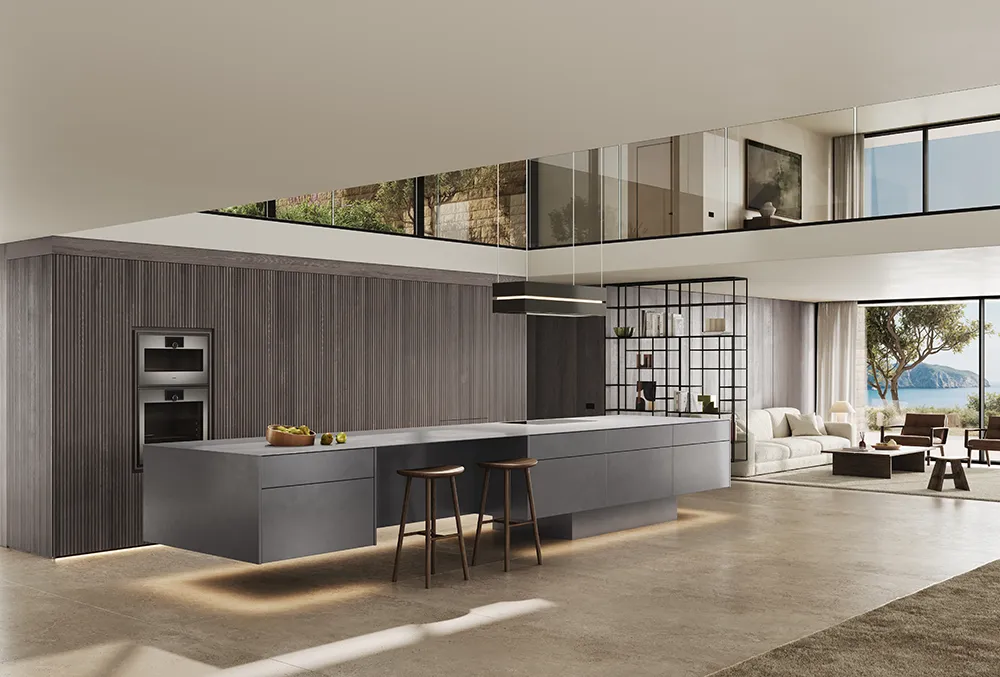
Some materials seek to shine. This one seeks to live. At the heart of the Floating Masterpiece in Port d’Andratx lies an island almost six metres long made of solid, hot-rolled stainless steel—a monolith that, despite its power, appears to float weightlessly above the floor. Anyone seeing it for the first time understands instantly that this is not merely a material used in construction, but one chosen for its character. Hot-rolled stainless steel is perhaps the most honest surface a kitchen can wear.
What distinguishes hot-rolled stainless steel
The name reveals its origin. Hot-rolled stainless steel is created when the steel is heated to over 1,100 degrees and rolled into its form while glowing hot. What remains is not a uniformly smooth surface, but a matt, vibrantly structured finish in which every slab differs from the next, almost like a natural stone. No pattern repeats; no two surfaces are identical. This is precisely where the beauty lies: the material visibly carries the story of its creation.
Stainless steel itself is a promise of permanence. Stainless steel is characterised by its high resistance to corrosion and the numerous demands of everyday kitchen life. In its hot-rolled, solid form, this robustness combines with an appearance that feels cool and warm at the same time.
Hot-rolled or polished: two temperaments
The difference compared to polished stainless steel is not one of degree, but of essence. Polished stainless steel—processed cold—becomes smooth, hard, and shiny; it reflects like a mirror and shows every fingerprint. Hot-rolled stainless steel takes the opposite path. Its surface is matt, deep, and calm; it does not throw light back but distributes it softly throughout the room. Where one shines, the other tells a story. For a home designed not for a quick effect but for longevity, this is a conscious decision.
How the material captures the light
In Mallorca, the capabilities of this surface are fully revealed. The Mediterranean light falling over the harbour of Port d’Andratx does not sit harshly upon the steel but sinks into it. The matt, subtly cloudy structure accepts every hour of the day differently—silvery in the morning, warm in the evening. Thus, the island becomes a silent mirror of its surroundings, an object that transforms with the room instead of imposing a fixed colour upon it. A carefully placed lighting design plays its part in bringing this texture to its full potential.
A patina that tells of life
Choosing hot-rolled stainless steel is a conscious decision in favour of the living. Unlike a sealed surface, this material develops a fine patina through daily use. Every mark, every gentle shimmer that appears over the years, is irrevocably inscribed into the surface and tells the story of the kitchen’s life. These signs cannot be undone, and that is not a flaw, but the actual appeal. Where flawless surfaces lose their allure over time, hot-rolled stainless steel gains depth. It does not age; it matures, just as the true materials of a bespoke handcrafted kitchen do. You can discover these in our Materials section.
The heart of the Floating Masterpiece
In the Floating Masterpiece, all these elements merge into a whole. The massive island was structurally calculated to appear self-supporting—a feat of engineering that transforms the power of the material into apparent weightlessness. Solid, hot-rolled stainless steel is not a decorative element here, but the core idea of the design. It embodies what Faber stands for: material honesty, uncompromising precision, and the courage to reduce. Solid stainless steel in this dimension and execution is mastered by only a few manufactories.
Whether your home deserves this character is best discovered in conversation. Experience the full impact of the Floating Masterpiece, learn about the pricing for a solid stainless steel kitchen, or arrange your personal planning consultation at your home.
Yours sincerely,
Michaela Faber
Frequently asked questions
What is hot-rolled stainless steel?
Hot-rolled stainless steel is stainless steel that is rolled at over 1,100 degrees while in a glowing state. This creates a matt, vibrantly structured surface that is unique to every slab. In its solid form, it is particularly robust, heat- and acid-resistant, and durable for generations.
What is the difference between hot-rolled and polished stainless steel?
Polished stainless steel is smooth, hard, and shiny, reflecting light like a mirror. Hot-rolled stainless steel is matt, deep, and vibrant, distributing light softly and showing a characteristic, irregular structure. Polished looks technical and flawless; hot-rolled looks natural and warm.
How does the patina develop on hot-rolled stainless steel?
The patina develops through daily use. Fine signs of wear and a gentle shimmer settle over the surface over time, giving it depth. These marks are intentional and cannot be reversed; they tell the story of the kitchen.
How do you care for a hot-rolled stainless steel worktop?
Ideally with a mild, grease-dissolving detergent and a soft cloth, always in the direction of the grain. Chlorine-based agents and abrasive sponges should be avoided. The natural patina is part of the material and does not need to be removed.
Who manufactures kitchens made of solid hot-rolled stainless steel?
Faber Küchenmanufaktur creates kitchens from solid, hot-rolled stainless steel, even in extraordinary dimensions. The Floating Masterpiece in Mallorca, with its stainless steel island nearly six metres long, is an impressive example.
How much does a kitchen made of solid hot-rolled stainless steel cost?
A kitchen made of solid, hot-rolled stainless steel is an individual custom-made product. At Faber, a smaller floating kitchen island without appliances starts at approximately 50,000 euros. Extensive projects with extraordinary dimensions, individual construction, and high-end interior fittings are correspondingly higher. The Floating Masterpiece shown, with its nearly six-metre-long stainless steel island, for example, is in the region of around 200,000 euros. The exact price is determined by planning, dimensions, material use, interior fittings, and the selection of appliances.